
August was a busy month for Progressive Practice Sales.
In just over a week, Crystal Misenheimer spoke at two major chiropractic conferences, and the PPS team finished the stretch with a booth at the Southern Chiropractic Conference hosted by the Tennessee Chiropractic Association.
The settings were different, but many of the conversations came back to the same questions chiropractors ask us every day:
- What is changing in chiropractic practice ownership?
- What makes one practice more valuable or transferable than another?
- Why do some practices stay profitable while others slowly lose ground?
- What should doctors be doing now if they may want to sell someday?
Those questions came up on stage, at the booth, and in conversations with doctors throughout the month.
FCA’s The National: How Chiropractic Practice Ownership Is Changing
On August 15, Crystal spoke at FCA’s The National in Orlando, Florida. Her presentation was titled “The Evolving Business of Chiropractic: Ownership Trends Every Doctor Should Understand.”
The business side of chiropractic has changed considerably over the past decade.
More doctors are approaching retirement. Larger ownership groups are buying practices. Buyers have access to more financing options, but lenders also expect much better documentation than they once did. Practice values are being scrutinized more closely, and buyers want to know that the income they are purchasing can continue after the seller leaves.
These changes matter even if a doctor has no plans to sell right now.
Many of the things that affect a chiropractic practice sale are built years before the practice ever reaches the market. Clean financial records, consistent profitability, a stable staff, documented systems, and revenue that is not completely dependent on the selling doctor cannot be fixed overnight.
That was an important part of Crystal’s FCA presentation.
Doctors who understand how buyers, lenders, and valuation professionals look at a chiropractic practice can make better decisions while they still have time to make changes.
For a deeper look at the presentation and the ownership trends Crystal discussed, read our recap of Crystal Misenheimer at FCA’s The National 2026.
You can also read The New Reality of Selling a Chiropractic Practice for more on how buyer expectations, financing, documentation, and valuations have changed.
Alabama State Chiropractic Association: Why Practices Thrive or Lose Ground
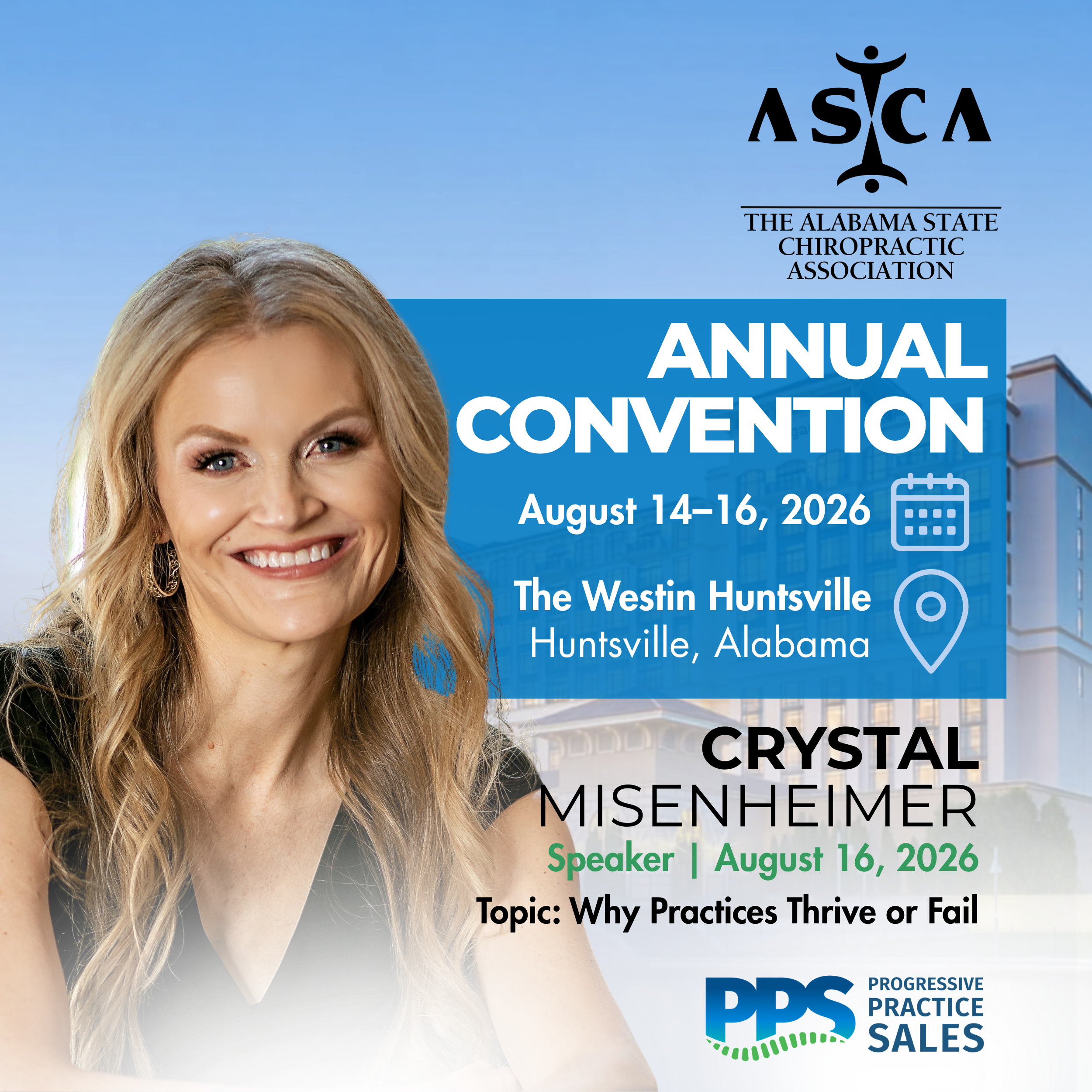
The next day, August 16, Crystal spoke at the Alabama State Chiropractic Association’s 100th Annual Convention in Huntsville.
Her presentation, “Why Practices Thrive or Fail: Lessons Learned from a Decade of Valuing and Analyzing Practice Efficiency,” focused on patterns PPS has seen after years of reviewing chiropractic practices.
Practices usually do not become difficult to run because of one major mistake.
Problems tend to build gradually.
Collections stay flat while payroll or other expenses increase. An associate is not producing enough to support the cost of the position. Patient retention slips. Reactivation stops being a priority. Financial reporting becomes inconsistent. The owner takes on more and more of the daily workload.
Each issue may look manageable on its own. Together, they can cut into profit and make the practice more dependent on the owner.
These problems also show up later during a valuation or sale.
A buyer looking at a practice wants to understand what they are actually purchasing. If the practice relies heavily on the seller, has inconsistent financial records, or cannot clearly explain how revenue is produced, the buyer and lender have more questions to answer before a transaction can move forward.
That is why practice efficiency and practice value are often closely connected.
Crystal’s session looked at practical areas doctors can review before small problems become larger ones, including:
- overhead compared with collections
- associate and staff utilization
- patient retention and reactivation
- financial reporting
- owner dependence
- cash flow
- systems that can be transferred to a new owner
You can read more about Crystal’s session in our post on the Alabama State Chiropractic Association’s 100th Annual Convention.
For doctors thinking further ahead, What Really Makes a Practice Hard to Sell explains why organized records and clear practice data matter so much once buyers and lenders become involved.
Southern Chiropractic Conference: Taking the Conversation to the Booth
From August 20 through 23, the PPS team was at the Southern Chiropractic Conference hosted by the Tennessee Chiropractic Association in Franklin, Tennessee.
This time, the conversations happened offstage.
At the PPS booth, we had the chance to meet doctors and industry professionals, reconnect with familiar faces, and answer questions about buying, selling, valuing, and preparing chiropractic practices for transition.
Some doctors were already considering a sale.
Others were looking at buying a practice or adding another location.
And plenty were simply trying to understand what their options might look like several years from now.
Those early conversations are useful because many practice sale issues are easier to address before there is a buyer waiting.
For example, a doctor who discovers several years before retirement that the practice is too dependent on their personal production has time to work on that. The same is true for inconsistent financial records, high overhead, an underused associate, or other issues that could later affect value or financing.
Doctors interested in practice ownership from the buyer side can also benefit from understanding these issues early. Starting from scratch and buying an existing practice come with very different financial and operational considerations. Our article, Thinking About Starting a Chiropractic Practice? Read This First, covers several of the numbers new owners should understand before committing to a start-up.
What We Heard Throughout August
The conferences were different, but the questions we heard were closely connected.
Doctors want to know what their practice is worth.
They want to know what buyers are looking for.
They want to understand financing.
They want to know when they should start preparing for a sale.
And many want to know how much of the sale process they can realistically handle themselves.
Those are reasonable questions, especially because most chiropractors will only sell a practice once.
A practice sale involves more than finding someone willing to buy it. Valuation, financial documentation, buyer qualification, lender requirements, due diligence, confidentiality, negotiations, and transition planning can all affect whether a deal reaches closing.
If you are considering handling a future sale yourself, Selling Your Chiropractic Practice Yourself Feels Like Control… Until It Isn’t explains some of the issues doctors often encounter once lenders, attorneys, and buyers begin reviewing the transaction.
Thank You to the Chiropractic Community
Thank you to everyone who attended one of Crystal’s sessions, stopped by the PPS booth, asked a question, or introduced themselves during this busy stretch of August.
Getting to talk directly with doctors is valuable for our team. We spend every day reviewing practices, valuations, buyer activity, financing issues, and transactions. Conferences give us the chance to hear what practice owners are thinking about before those questions turn into an active sale or acquisition.
We appreciated the conversations and the opportunity to share what we see from the practice sales side of chiropractic.
Frequently Asked Questions
When should I start preparing to sell my chiropractic practice?
Ideally, start several years before you plan to sell. That gives you time to clean up financial records, address profitability issues, reduce owner dependence, strengthen your team, and fix problems that may affect financing or value.
You do not need to be ready to list your practice to begin preparing.
What makes a chiropractic practice easier to sell?
Buyers and lenders generally want financial information they can verify, consistent profitability, transferable systems, stable staffing, and confidence that patients and revenue will remain after the seller leaves.
A practice that is easy to understand is usually easier for a buyer and lender to evaluate.
Does a profitable chiropractic practice automatically have a high value?
No. Profitability is important, but it is not the only factor.
A valuation can also be affected by the quality of the financial records, owner dependence, staffing, payer mix, equipment, growth trends, lease terms, transferability, and other practice-specific factors.
If you want a better understanding of your own numbers, learn more about chiropractic practice valuations.
Can I sell my chiropractic practice if I am still the main treating doctor?
Yes. Many chiropractic practices are sold while the owner is still the primary treating doctor.
The important question is how transferable the patient base and revenue will be to a new owner. If nearly every part of the business depends personally on the seller, the transition may require more planning.
Can I sell a chiropractic practice that has an associate?
Yes. An associate can sometimes make a practice more attractive because the buyer is acquiring an existing provider and additional production capacity.
But the associate’s role, compensation, production, tenure, and willingness to remain after the sale all matter. An associate does not automatically increase value.
Do I need a valuation if I am not ready to sell yet?
A professional valuation can be valuable well before you are ready to sell. It shows you how your practice is viewed from a financial and market perspective today and helps identify factors that could affect its future value. Some of those factors take several years to improve, so understanding them early gives you more time to make meaningful changes before a sale.
Is buying an existing chiropractic practice better than starting one?
It depends on the doctor and the opportunity.
An existing practice may come with patients, staff, equipment, systems, and immediate cash flow. A start-up gives the owner more freedom to build the practice from the beginning but often requires more time and working capital before it becomes profitable.
An existing practice may come with an established patient base, staff, equipment, systems, and cash flow from day one. A start-up gives the owner more freedom to build the practice from the ground up, but it also requires time to build a patient base and generate enough revenue to support both the business and the owner.
Research on chiropractic practice start-ups has found that it can take an average of three years to establish a self-sustaining practice. That makes available working capital an important part of the decision. A doctor considering a start-up should be financially prepared not only for the initial costs of opening the practice, but also for the period of time it may take for the business to consistently cover its expenses and provide adequate income to the owner.
Can I sell my chiropractic practice without a broker?
Yes, a practice owner can sell without a broker.
The seller will need to handle or coordinate valuation, marketing, confidentiality, buyer screening, negotiations, lender requests, due diligence, attorneys, and the transition. Doctors considering this route should understand the full transaction process before deciding which parts they want to manage themselves.
For sellers who want to stay more involved while reducing the cost of a traditional full-service brokerage, hybrid sale programs can provide support with the most important parts of the transaction while allowing the owner to handle other aspects of the sale directly.
Related Resources
Continue reading about chiropractic practice ownership, valuation, and sales:
- The New Reality of Selling a Chiropractic Practice
- Thinking About Starting a Chiropractic Practice? Read This First.
- Selling Your Chiropractic Practice Yourself Feels Like Control… Until It Isn’t
- What Really Makes a Practice Hard to Sell
- Crystal Misenheimer to Speak at FCA’s The National 2026
- Crystal Misenheimer at Alabama Chiropractic Convention 2026
Interested in Having Crystal Speak at Your Event?
Crystal speaks on chiropractic practice ownership, valuation, profitability, growth, and practice transitions.
If you’re planning a chiropractic conference, association event, webinar, or industry program and would like to have Crystal speak, learn more here: